Thinking a little more about ‘notability’ —
If you look at the deadpool, you see a lot of entries like this:
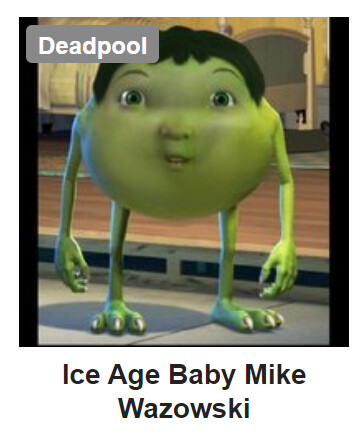
I have no doubt that this image was seen by at least 1000 people, but I’m not convinced that it is a meme proper. At present, it really just seems to me like a mash-up or crossbreed; a member of one or both of its parent genera.
This doesn’t mean it couldn’t become a meme-unto-itself in the future, though. It is at least conceivable for “Ice Age Baby Mike Wazowski” to have gotten enough traction to take on life as a character of his own, sort of like Pepe or Doge (actually, I think the best example would be Lord Marquaad).
What this tells us is that there’s a certain level of ‘critical mass’ or ‘critical attention’ that a given memetic artifact needs to reach to metastasize beyond the level of one-off joke or reference, even if these artifacts are getting utilised in the practice of ‘memeing’. This attention also needs to be of the right, fertile type for ‘memeogenesis’ and continued survival — I still believe that it’s worthwhile to distinguish simple virality from mimesis (and memeogenesis), although they are related.
This is all pretty tangential, but I think my takeaway is basically that you need ‘notability’ criteria in an endeavour like this, and not only as a practical matter. Ideally these criteria would be trying to approximate criteria which are out there somewhere in collective consciousness(es)*, which are helping people (even at a n ad-hoc, subconscious level) to discriminate between classes and members.
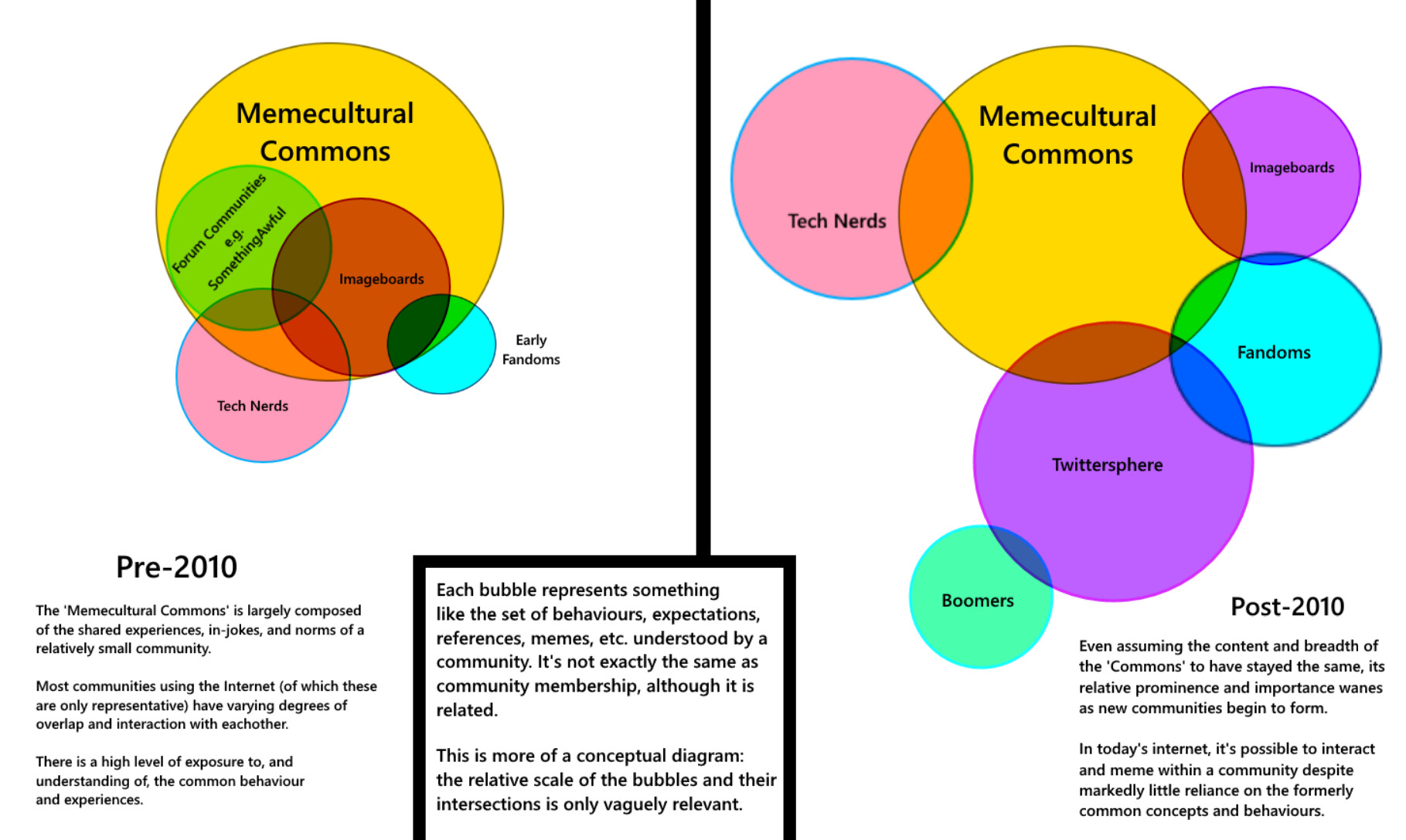
* I specify that there might be multiple ‘consciousnesses’ because these subjective criteria could even differ from subculture to subculture; notability could be radically relative. You can have memes that totally blow up a small community that nevertheless have no impact on the mainstream. This is related to the ‘rate of proliferation’ point in various ways — most notably, I think, in that fact that there is no longer a mostly-singular, mostly-homogenous meme community anymore. Another way of putting it is that the memetic common-stock of behaviours and ideas has gotten comparatively smaller over the years. The Internet population grew while memetic-literacy barriers remained fairly rigid, or became antiquated; I think what has happened is that people who couldn’t or didn’t want to into that part of the culture just ended up forming their own communities, with fewer connections to what was previously considered the cultural commons. Here is an abominable and nonsensical paint.net diagram: